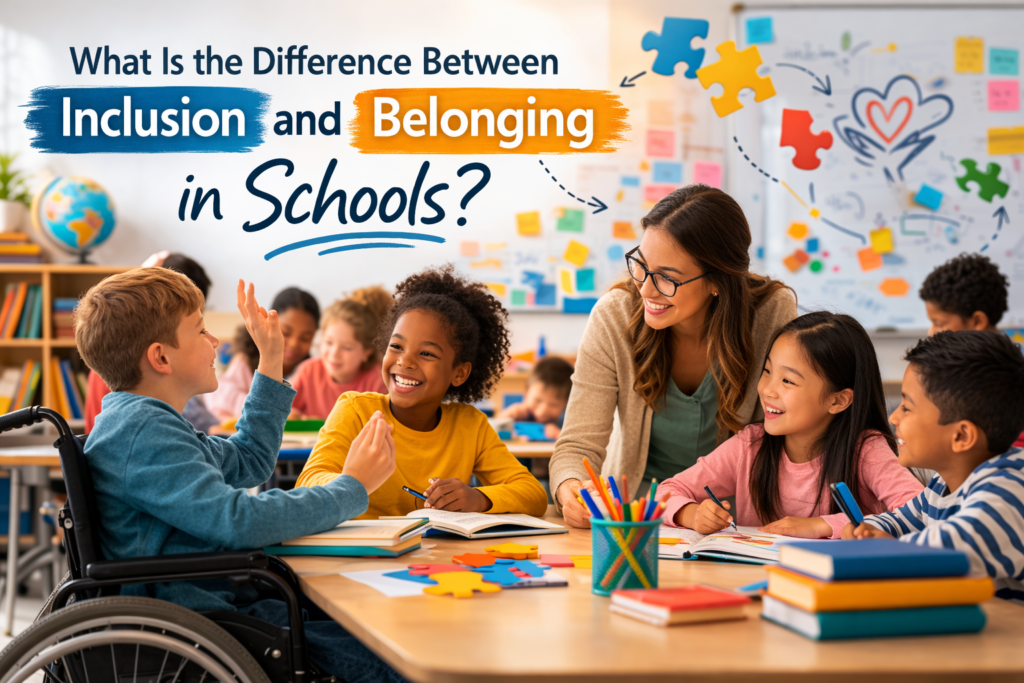

Across the country, schools have made significant progress in expanding access and inclusion for students with disabilities. Classrooms are more integrated, policies have evolved, and educators increasingly recognize the importance of inclusive learning environments.
Yet many schools quietly encounter a common challenge: inclusive policies exist, but inclusive practices remain inconsistent.
This gap often has less to do with teacher commitment and more to do with something deeper — the influence of professional culture. Without ongoing professional development focused on inclusive practices, even the most well-intentioned educators can gradually adopt the routines and expectations already embedded within a school.
In other words, the status quo has gravity.
The Gravity of the Status Quo
New educators often enter the profession with strong ideals about equity, inclusion, and student belonging. However, once inside the daily structures of a school, they quickly learn how things are typically done.
Research examining educator perceptions of inclusion has shown that teacher attitudes toward inclusive practices are strongly shaped by their training and support systems. When teachers feel prepared and supported, they are more likely to implement inclusive strategies with confidence. When that support is absent, implementation often becomes minimal or inconsistent (Civitillo, De Moor, & Vervloed, 2017).
This does not reflect a lack of dedication. Instead, it reflects a natural human tendency: people adapt to the systems they enter.
Professional development helps schools interrupt that drift toward routine and refocus educators on the purpose behind inclusive practices.
What Research Reveals About Professional Development Needs
Studies examining inclusive education consistently show that teachers need ongoing opportunities to develop practical strategies for working within diverse classrooms.
Educators often report needing support in areas such as:
• collaboration between general education and special education teachers
• instructional strategies for inclusive classrooms
• interpreting and implementing individualized education plans
• understanding how peer relationships influence student learning
Research has also shown that teachers who receive structured training related to inclusion report greater confidence in adapting instruction and supporting diverse learners (Civitillo et al., 2017).
In other words, professional development does more than introduce new ideas. It builds the confidence necessary to translate inclusive values into daily classroom practice.
The Role of Teacher Perceptions
Another important finding in the research is the influence of teacher perceptions.
How educators interpret inclusion — whether they see it as feasible, beneficial, or overwhelming — shapes how they implement it. Studies consistently demonstrate that teacher attitudes toward inclusive education are closely linked to the training and support they receive (Civitillo et al., 2017).
This means school leaders must be willing to examine perception data honestly.
If educators report uncertainty about how to implement inclusive practices, ignoring that data does not resolve the issue. Instead, it allows uncertainty to quietly influence classroom decisions.
Addressing teacher perceptions through professional development, coaching, and collaborative dialogue helps transform uncertainty into shared problem-solving.
A Quick Reflection for School Teams
One of the most productive ways to begin addressing inclusive culture is to examine how belonging currently functions within the daily routines of a school.
Small structural questions can reveal whether students are experiencing authentic connection or simply sharing the same physical spaces.
To help educators begin this reflection, I created a short School Belonging Snapshot — a five-question tool designed for teachers, administrators, and leadership teams who want to evaluate how their campus currently supports peer interaction and belonging.
You can download the free reflection tool here:
Download the School Belonging Snapshot
Sometimes the most meaningful insights begin with a few well-placed questions.
Professional Development as Cultural Design
Professional development is often treated as a compliance requirement or a series of isolated training sessions. When approached this way, its impact tends to fade quickly.
But when professional learning becomes part of a school’s cultural design, its influence becomes much deeper.
Effective professional development helps educators:
• develop shared language around inclusion
• understand the purpose behind inclusive structures
• learn practical strategies that can be applied immediately
• collaborate with colleagues across roles
Over time, this shared learning begins to reshape how teachers interpret their work. Instead of viewing inclusion as an additional responsibility, educators begin to see it as a collective effort embedded within the culture of the school.
Why Schoolwide Focus Matters
Inclusive practices cannot depend solely on individual teachers. When the responsibility for inclusion rests on isolated classrooms, progress becomes inconsistent and fragile.
Schoolwide professional development helps establish a shared understanding of how inclusive culture should function across a campus.
This collective understanding also helps new educators enter a culture that supports belonging rather than one that unintentionally maintains separation.
In many ways, professional development acts as the bridge between inclusive policy and inclusive practice.
Why This Work Matters Now
Schools today face growing expectations to support diverse learners while strengthening social connection and belonging across campuses.
Meeting those expectations requires more than goodwill. It requires intentional learning for the adults responsible for shaping school culture.
When professional development remains focused on inclusion, educators are more likely to build environments where students experience meaningful relationships, shared responsibility, and authentic participation in school life.
These ideas are explored more deeply in my book:
The Inclusion Illusion: Why Students With Disabilities Still Feel Isolated, and What Schools Can Do About It
The book examines why physical access alone does not always lead to social belonging and how schools can intentionally design structures that help students build meaningful connections.
Research Referenced
Civitillo, S., De Moor, J., & Vervloed, M. (2017). Educators’ perceptions of inclusive education and the role of professional development. Taylor & Francis.
https://www.tandfonline.com/doi/full/10.1080/2331186X.2017.1313561