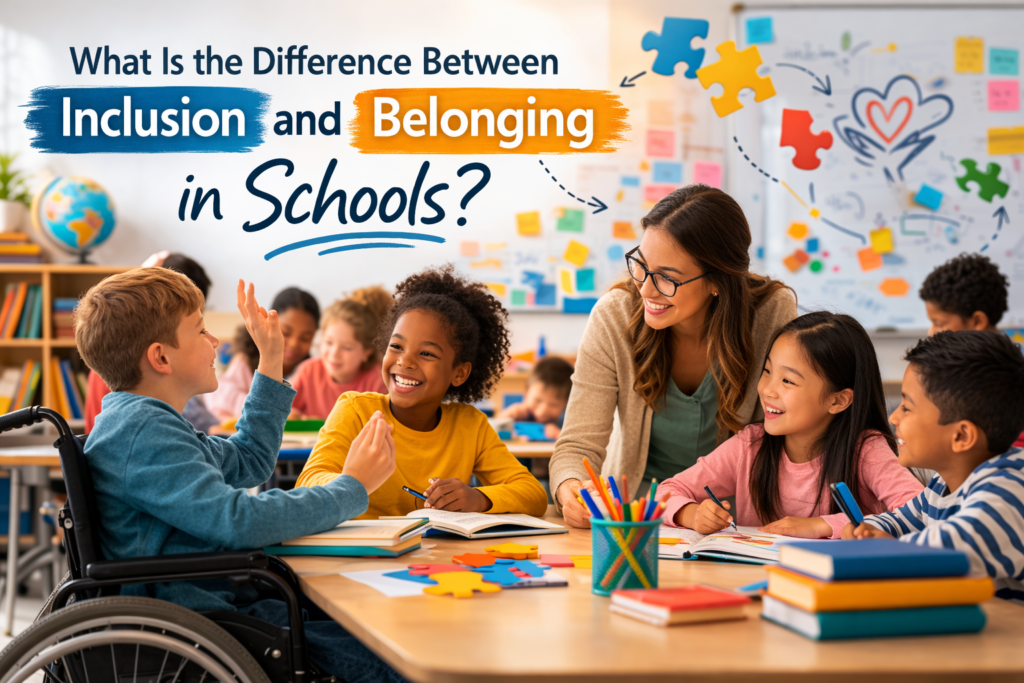
In recent years, the word inclusion has become one of the most widely used terms in education. Schools proudly highlight inclusive classrooms, inclusive activities, and inclusive policies designed to ensure that students with disabilities have access to the same educational environments as their peers.
This progress is meaningful and necessary. But educators are increasingly recognizing that inclusion and belonging are not the same thing.
Students can be included in a classroom without necessarily feeling that they belong there.
Understanding this distinction can help schools strengthen the social and emotional experience of students across a campus.
What Inclusion Means in Education
In education, inclusion generally refers to the practice of educating students with disabilities alongside their nondisabled peers to the greatest extent possible.
Policies such as the Individuals with Disabilities Education Act emphasize educating students in the least restrictive environment, which encourages schools to provide access to general education settings whenever appropriate.
Inclusion focuses primarily on placement and access. It ensures that students share classrooms, learning opportunities, and school experiences.
This is an essential foundation for equity in education.
But placement alone does not guarantee social connection.
What Belonging Means in Schools
Belonging goes a step further.
Belonging describes the experience of feeling valued, connected, and recognized as a meaningful member of a community. In schools, belonging often emerges through relationships with peers, shared experiences, and opportunities to contribute.
When students feel they belong, they typically experience:
• consistent peer relationships
• opportunities to collaborate and contribute
• recognition of their strengths and abilities
• a sense that their presence matters
Belonging is not created through placement policies. It develops through interaction, shared responsibility, and everyday relationships.
Why the Difference Matters
When schools focus only on inclusion, they may unintentionally overlook the social dynamics that shape student experience.
Students may sit in the same classrooms but interact with entirely different groups. They may attend the same assemblies but participate in separate activities. Over time, this quiet separation can limit opportunities for friendships to develop.
Research on school belonging consistently shows that students who feel connected to their peers and school community demonstrate stronger motivation, greater engagement, and improved academic outcomes.
Belonging strengthens both learning and well-being.
How Schools Begin to Bridge the Gap
Schools that successfully move from inclusion to belonging usually focus on designing opportunities for students to interact in meaningful ways.
Some of the most effective strategies include:
• peer mentorship programs
• collaborative projects and group roles
• student leadership initiatives
• shared extracurricular activities
• intentional interaction during unstructured time
These structures help students build relationships that go beyond simply sharing space.
Over time, repeated interaction helps transform proximity into connection.
A Simple Way to Reflect on Your School’s Culture
For educators who want to explore how belonging currently functions within their school, reflection can be a helpful starting point.
I created a short tool called the School Belonging Snapshot to help teachers and school leaders consider whether students are experiencing authentic peer connection or simply sharing the same physical spaces.
The five-question reflection can help identify where belonging is already happening and where additional structures might strengthen relationships.
You can download the free reflection tool here:
Download the School Belonging Snapshot
Looking Beyond Inclusion
As schools continue working toward more inclusive environments, many educators are beginning to ask a deeper question: what does it take for every student to feel like a genuine part of the community?
This question is explored more fully in my book:
The Inclusion Illusion: Why Students With Disabilities Still Feel Isolated — and What Schools Can Do About It
The book examines why physical inclusion does not always lead to social belonging and how schools can intentionally design structures that help students build meaningful relationships.
Inclusion is an important first step.
Belonging is what allows that inclusion to fulfill its promise.