
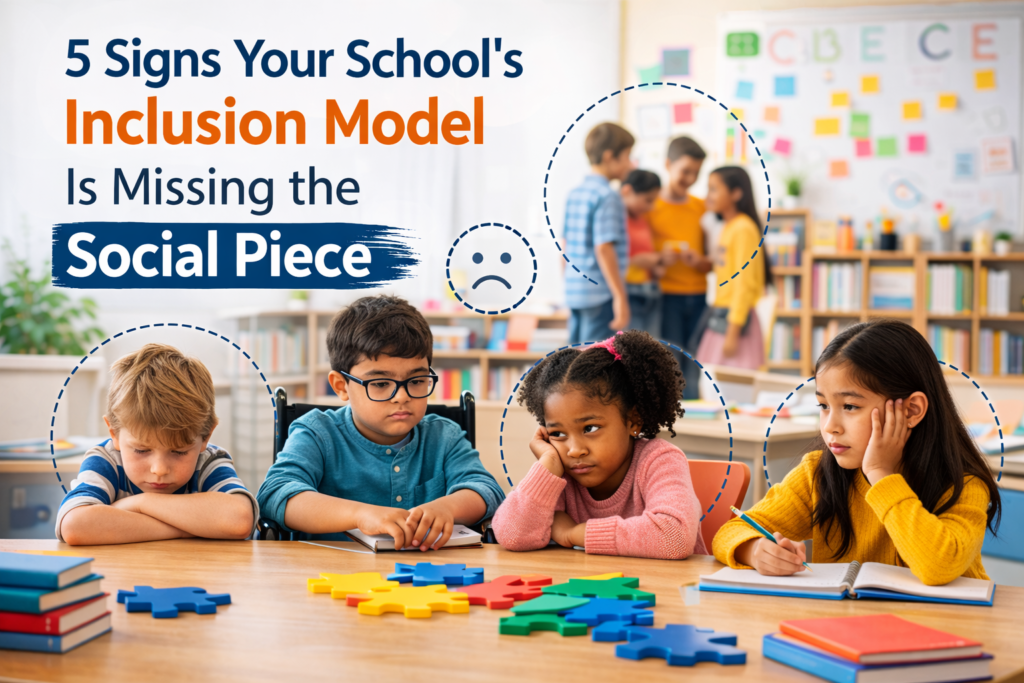
In many schools today, inclusion has improved dramatically in terms of access. Students with disabilities share hallways, cafeterias, assemblies, and classrooms with their general education peers. On paper, this represents real progress.
But physical proximity does not always guarantee social connection.
Educators often sense this difference instinctively. Students may sit near one another throughout the day while still moving through school life on entirely separate paths. Over time, this quiet separation can shape how students see themselves and their place within the school community.
For schools committed to strengthening inclusive culture, it can be helpful to step back and look for subtle indicators that the social side of inclusion may still need attention.
Here are five signs that an inclusion model may be missing an important piece.
1. Students Share Space but Rarely Share Activities
Students may attend the same classes or events, but they rarely participate in meaningful activities together. Interaction often happens only when adults intentionally structure it.
True belonging usually emerges when students collaborate, solve problems, or work toward shared goals together. Without those shared experiences, proximity alone rarely produces lasting relationships.
2. Peer Interaction Happens Only During Special Events
Many schools do a wonderful job creating inclusive experiences during assemblies, spirit weeks, or special campus programs.
However, if peer interaction mainly occurs during these moments, it may not yet be embedded into the everyday rhythm of school life.
Belonging tends to grow through consistent, ordinary interactions rather than occasional events.
3. Students With Disabilities Are Rarely Seen in Meaningful Roles
When students are consistently placed in passive roles, their peers may not have opportunities to see their abilities, interests, or contributions.
Meaningful roles—whether during projects, clubs, or collaborative activities—help shift how students view one another. Shared responsibility often leads to shared respect.
4. Unstructured Time Reinforces Separation
Some of the most important social moments in a school day happen outside formal instruction: lunch, transitions, extracurricular activities, and campus events.
If these moments consistently reinforce separation between student groups, it may signal that the school’s structures unintentionally limit opportunities for connection.
5. Inclusion Is Seen as a Program Rather Than a Culture
In some schools, inclusion is associated with a specific initiative, club, or class. While programs can be valuable, belonging becomes much stronger when it is woven into the culture of the campus.
When schools intentionally design routines that bring students together regularly, relationships become a natural part of the school experience rather than a scheduled activity.
A Simple Place to Start
Understanding whether belonging is functioning across a campus can begin with a few simple questions.
To help educators reflect on this idea, I created a short School Belonging Snapshot, a five-question reflection tool designed for teachers, administrators, and leadership teams.
The tool can help schools identify whether students are simply sharing space or actually building relationships.
You can download the free reflection tool here:
Download the School Belonging Snapshot
Looking Deeper
These questions are explored more fully in my book:
The Inclusion Illusion: Why Students With Disabilities Still Feel Isolated — and What Schools Can Do About It
The book examines why physical inclusion alone does not always produce social belonging and how schools can intentionally design structures that help students build meaningful connections across ability differences.
Inclusion is an important first step.
Belonging is what comes next.